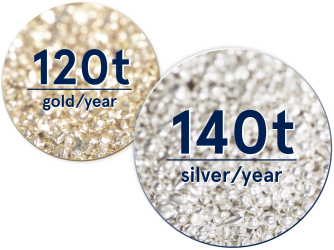
With an annual production capacity of 120 tons of gold and 140 tons of silver, we rely on state-of-the-art technologies. The focus is on sustainability: a closed water cycle and a large photovoltaic system ensure resource-efficient production.
With the opening of our refinery, we are not only a full-service provider for precious metals and storage, but also a producer of our own philoro bars, enabling active recycling of precious metals.
At philoro GOLDWERK we produce gold bars “MADE IN AUSTRIA” and recycle gold, silver, platinum, and palladium to the highest quality standards.
An insight into the value chain through precious metal recycling
The GOLDWERK plays a pioneering role in the implementation of the circular economy. The recycling of scrap gold and the reuse of materials are not only part of our production philosophy, but also contribute to creating a circular value chain and closing gaps in the precious metals value cycle. In this way, we also contribute to the sustainable use of valuable resources.
Our sustainability efforts at GOLDWERK are comprehensive. We not only value the use of recycled precious metals, but also focus on environmentally friendly production practices.
This enables us to not only minimize our environmental impact, but also actively contribute to promoting sustainable sourcing.
philoro emphasizes its commitment to the highest quality standards and marks the next major milestone with the goal of achieving certification by the London Bullion Market Association (LBMA).
What does this mean for our customers?
Customers who invest in sustainable practices can achieve long-term cost savings while contributing to responsible business practices. The use of recycled precious metals, especially scrap gold, enables customers to purchase high-quality products without bearing the costs of mining new raw materials. This not only makes sense from an environmental perspective, but is also financially advantageous.
Our sustainable production processes help to reduce waste and create more efficient processes. This can lead to lower production costs and results in greater planning security.