At philoro, the responsible use of valuable resources is our top priority. Through professional recycling of precious metals, we recover raw materials from secondary gold sources, such as jewelry, dental gold, and other precious metal sources.
Our production is divided into four main areas:
Laboratory & Analytics
Melt
Wet chemistry
Minting
The Path to becoming a Certified Bar
The production of our ingots is based on a carefully coordinated combination of laboratory analysis, metallurgical processing, and precision manufacturing technology. Every step is accompanied by quality controls to ensure purity, safety, and traceability.
Analyses are performed in particular when material is transferred between two process steps. In addition, we regularly monitor our processes. This ensures that both product quality and environmental standards are maintained at all times.
The Recycling process at philoro
1. Laboratory & Analytics
The quality of our precious metals is continuously monitored throughout the entire production process. Analyses are conducted upon receipt of goods, between individual processing steps, and prior to final product approval.
X-ray fluorescence (XRF), cupellation, and ICP-OES are used to determine fineness and metal composition. By combining these methods, we ensure reliable quality assessment throughout the entire production chain.
2. Melting and Homogenization
Incoming precious metal material is first recorded and documented in the laboratory. It is then melted down to create a homogeneous sample. This so-called “planche” serves as the basis for analyzing and evaluating the precious metal content. Based on these results, the material is evaluated and billed to the customer.
Material that remains in further processing is further refined in the smelter. Depending on the process stage, this produces various intermediate products that are prepared for subsequent refining or production. Different smelting furnaces are available for different materials. This ensures that high-purity materials are not contaminated.
3. Wet chemistry
Pre-processed materials are leached in suitable chemical solutions so that the metals they contain can be separated from one another. Through targeted chemical reactions, precious metals can then be recovered from the solution.
The recovered gold is filtered, washed, and dried. It is then remelted and processed into high-purity granules. In addition to gold, other precious metals such as platinum, palladium, and copper can also be separated and recovered in this process.
4. Silver Refining and Electrolysis
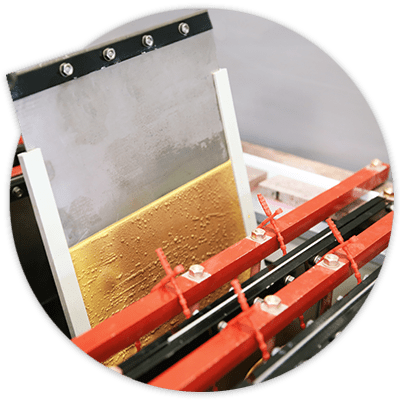
The silver processing procedure also includes electrolytic refining.
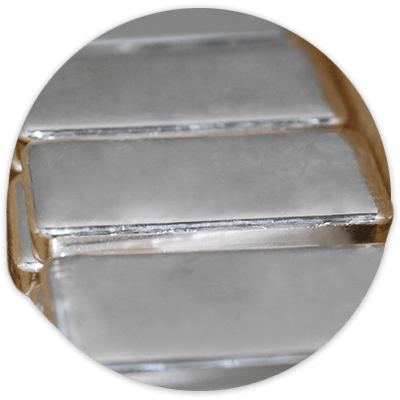
In this process, silver ions are transported from one electrode to another in an electrolyte solution and precipitate in a highly pure form. The refined silver is then dried and remelted. The resulting granules form the basis for further processing.
Minting - Bar Production
After refining, the mechanical processing of the precious metals begins to produce the final products.
1. Continuous Casting & Rolling
The high-purity precious metal granules are first processed into metal strands in continuous casting machines. These strands serve as the raw material for further processing. Gold and silver are processed on separate lines to prevent the materials from mixing.
The cast strands are then precisely rolled until the desired material thickness is achieved. This precision is crucial to ensure that the blanks punched out later correspond exactly to the intended weight.
2. Stamping, cleaning, and polishing
Blanks are punched out of the rolled metal strips; these are known as rounds or ingot blanks. After punching, they are cleaned, weighed, and sorted automatically.
The blanks are processed in polishing machines and cleaned in ultrasonic baths. This removes any impurities and optimally prepares the surface for embossing.
3. Embossing
The blanks are stamped under high pressure. This process creates the bars’ distinctive surfaces and designs. After stamping, the bars are laser-marked and packaged, along with a certificate.
Production of cast bars
To produce cast bars, gold is melted down and poured into special molds. As the gold cools, unique solidification lines form, making each bar one-of-a-kind. The product is also marked with relevant details such as the manufacturer, weight, and fineness.
Environmental Safety & Process Control
All production areas are equipped with modern extraction and filtration systems. Process gases from chemical reactions and flue gases from melting processes are purified using air scrubbers and filtration systems.
Wastewater from production is also regularly analyzed and treated. Compliance with regulatory limits is continuously monitored and documented. These form the basis for meeting safety requirements.